
Jackaroo capture and protection: how to keep your marbles safe
How capturing works in Jackaroo, which marbles are protected, how the King's sweep and the Jack can reach you, and how to keep your marbles safe.
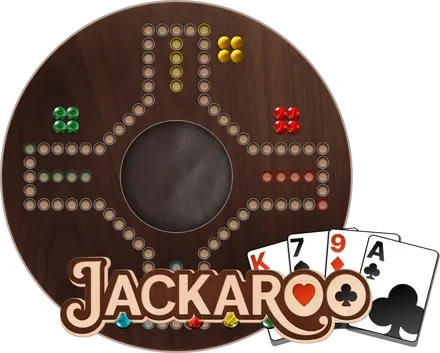
A captured marble goes back to base, and only an Ace or a King can bring it out again. That makes capturing one of the biggest swings in Jackaroo. This guide covers exactly when a marble can be sent back, when it is safe, and how to use both sides of that rule. If you’re new to the cards themselves, start with Jackaroo for beginners: what every card does.
How a capture works
The rule is short: landing on an unprotected marble sends it back to base. The important word is landing. Your move has to end exactly on the space where the marble sits.
Example: an opponent’s marble is 8 spaces ahead of yours. An 8 lands on it and sends it back to base. A 9 or a Queen ends on a different space, so neither captures it.
Forward moves reach every distance from 1 to 13: the Ace gives 1 or 11, the number cards move by their value, the Queen 12 and the King 13. The Four moves backward, so 4 forward only comes from splitting a Seven (4 + 3). In practice, any opponent’s marble up to 13 spaces behind yours is a threat to it.
The King’s sweep
The King’s 13-step move is the one move that captures more than the space it ends on. It sends every unprotected marble along its main-track path back to base, including your own and your partner’s. Two details matter:
- A protected start space on the path blocks the move.
- Leaving base with a King doesn’t sweep anything.
Example: you hold a King. In the 13 spaces ahead of your marble there are two opponents’ marbles and nothing else. Playing the King sends both back to base. If your partner’s marble were also in that stretch, it would go back too, so count before you play.
Where a marble is protected
Not every marble can be captured or swapped. Here is where each of yours stands:
- On its own start space: protected. Landing can’t capture it, a Jack can’t swap it, another player’s Five can’t move it, it blocks passage, and it blocks the King’s 13-step move.
- In the home lane: a Jack can’t swap it, and the King’s sweep runs along the main track. Home-lane marbles also can’t be jumped over, so you need the exact number of steps to reach a free home space.
- In base: it can’t be swapped, but it isn’t helping you either. It needs an Ace or a King to come out.
- Anywhere else on the main track: unprotected. It can be captured by landing, sent back by a King’s sweep, swapped by a Jack, or moved by another player’s Five.
Note the word own: the protection belongs to a marble standing on its own start space.
The start space as a wall
Because a marble on its start space blocks passage, it can hold up marbles coming from behind it, and it stops a King’s 13-step move from going through. That makes a freshly placed marble a useful wall when opponents’ marbles are approaching.
The catch is that it blocks everyone. In Classic, your partner’s marbles have to get past your start space too, and a wall that holds up your partner costs your team time.
Staying out of reach
These are habits, not rules, but they save a lot of marbles:
- Count back 13 spaces from each of your marbles. Opponents’ marbles in that stretch can reach you with many cards.
- Don’t leave a marble waiting on the main track just before your home lane. It is the most valuable target for a Jack swap.
- Move into the home lane when the count allows. There, a Jack can’t swap you.
- Leave your start space on purpose, when the marbles behind you are far away.
Capturing well
A capture costs your opponent all the progress that marble made, plus an Ace or a King to bring it out again. Still, check where your own marble will stand afterwards.
Example: an opponent’s marble is 6 spaces ahead of yours, and a second opponent’s marble is 2 spaces behind yours. Playing a 6 captures the first one, and your marble ends 8 spaces ahead of the second: still in reach, but further away than before. That is usually a good trade. If a capture would leave you just 1 or 2 spaces in front of another opponent’s marble, weigh it more carefully.
To see how swaps change these sums, read the Jack and the Queen in Jackaroo. For the complete rules, see Jackaroo rules and how to play.
Keep your marbles safe in your next game of Jackaroo in Diwaniye.